
You get guitar students when people can find you, trust you and book a lesson in a few clicks. This guide gives ten steps for doing that. Each step ends with one action for this week.
Step 1: Pick your student and your style of music
People search by instrument, style and place. They type “guitar teacher near me” or “blues guitar lessons online”. A teacher who offers lessons for everyone matches none of these searches. Choose one group to start with. Pick an age range, a level and a style. Decide if you teach in person, online or both. Then write your offer in one sentence. Example: “Online fingerstyle guitar lessons for adult beginners who can practice 20 minutes a day.” Use that sentence on your homepage, your lessons page and your social profiles. A narrow offer is easier to find and easier to remember.
Choose one style of music
When you target everyone, you reach no one. A student who wants flamenco looks for a flamenco teacher. Searchers name a style, list searches such as “classical guitar teacher” and “jazz piano lessons”.
Pick the style you play best and enjoy most. Build your offer, your lessons page and your content around it.
| Style | Offer line | Content ideas |
|---|---|---|
| Classical | Classical guitar lessons for adults who want to play repertoire. | Right-hand position, slow practice of a study, how to read a score. |
| Rock | Rock guitar lessons for teens who want to play in a band. | Riffs from famous songs, power chords, tone settings for an amp. |
| Flamenco | Flamenco guitar lessons for players who want authentic rhythm. | Rasgueado technique, basic compás patterns, a short falseta breakdown. |
| Blues | Blues guitar lessons for players who want to improvise. | The 12-bar blues, pentatonic licks, bending technique. |
| Fingerstyle | Fingerstyle guitar lessons for players who want to arrange songs. | Thumb independence, arrangements of popular songs, alternating bass patterns. |
| Metal | Metal guitar lessons for players who want speed and control. | Palm muting, alternate picking drills, riff breakdowns. |
| Worship | Guitar lessons for players who want to lead worship. | Chord charts, clean chord changes, how to use a capo. |
A classical teacher posts classical videos. A rock teacher posts rock riffs. Every video tells a student of that style that you teach what they want to learn. Use the words of your style on your lessons page, in your video titles and in your Google Business Profile description. Post only that style for your first twelve weeks. You can still teach other styles to students who ask. Your marketing speaks to one group.
This week: write your one-sentence offer, name your style of music in it and put it at the top of your homepage.
Step 2: Build a lessons page that gets enquiries
Your lessons page is where a searcher decides to contact you. Write titles that say what the page covers, such as “Online Guitar Lessons” or “Music Lessons for Kids”. A title like “Services” tells Google and visitors nothing.
Put these on the page:
- A heading with the lesson type and place, such as “Beginner Guitar Lessons in Austin”.
- Two sentences saying who the lessons are for and what they will play after eight weeks.
- The lesson length, the format and how booking works.
- A short video of you teaching. let a visitor see your style before they write to you.
- Two or three testimonials with a first name and the student’s level.
- One button that says “Book a trial lesson”.
Write the first two sentences so they answer the search on their own.
This week: rewrite your lessons page using the list above.
Step 3: Show up in local Google search
Music lessons are local. A parent or adult beginner types “guitar lessons near me” and looks at the map and the first few listings. MakeMusic says the map results at the top are driven almost entirely by your Google Business Profile.
Claim or create your profile at Google Business Profile. Then do these things:
- Choose the closest category, such as Music Instructor or Music School.
- Add your lessons page as the website link.
- Add photos of your teaching space or your guitars.
- Use the service area option if you teach from home, so your address stays hidden.
- Keep your name, address and phone number the same on your website, your profile and every directory. Seopital advises keeping this information accurate and consistent.
Ask for a review right after a student has a good lesson, and send the review link in the same message.
This week: claim or update your profile and send the review link to your five longest-standing students.
Step 4: Get named by AI assistants
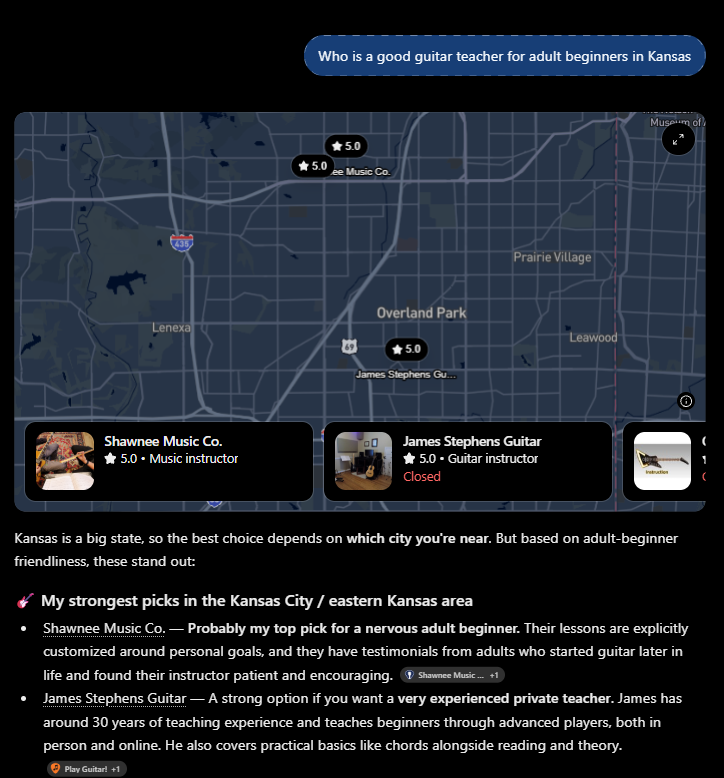
Students can ask ChatGPT, Gemini or Google’s AI answers to recommend a guitar teacher. You can check what they say about you in ten minutes.
Ask each assistant five questions a student would ask. Examples:
- Who is a good guitar teacher for adult beginners in [your city]?
- Where can I take online fingerstyle guitar lessons?
- What should a guitar teacher website include?
- How much do private guitar lessons cost in [your city]?
- Which guitar teachers offer a free trial lesson near me?
Write down if your name appears and which websites the assistant cites. Then list your lessons on the sites that show up, and keep your name, location and offer the same on all of them. Nobody controls these answers. A clear lessons page, consistent listings and Google reviews give the assistants accurate facts about you to repeat.
This week: ask the five questions in ChatGPT or other AI tool and save the results in a note.
Step 5: Ask current students for referrals
Tom Hess says referrals spread your reputation and reduce the advertising you have to write. A referred student already trusts you before the first lesson. Ask at a good moment. A student who has just played a full song for the first time is ready to tell a friend. Send a short message:
“I have two openings next month. If you know someone who wants to learn guitar, I will give them a free first lesson.”
Referral rewards and first-lesson discounts as common ways teachers encourage word of mouth. Pick one reward and keep it the same for every student. Thank every student who refers someone, even if the friend does not book.
This week: send the message above to three students who are making good progress.
Step 6: Offer a trial lesson and make booking easy
A free or low-cost first lesson removes the risk for a new student.
Set up the trial like this:
- Keep it to 30 minutes so it is easy to say yes.
- Use a booking link or a short form. Ask the student’s level, their goal and the days they are free.
- Reply to every enquiry within one day.
- End the lesson with a plan for the first four weeks and the price of a lesson package.
A calendar link removes the back-and-forth emails.
This week: add a booking link or a short form to your lessons page.
Step 7: Post helpful content on YouTube and social media
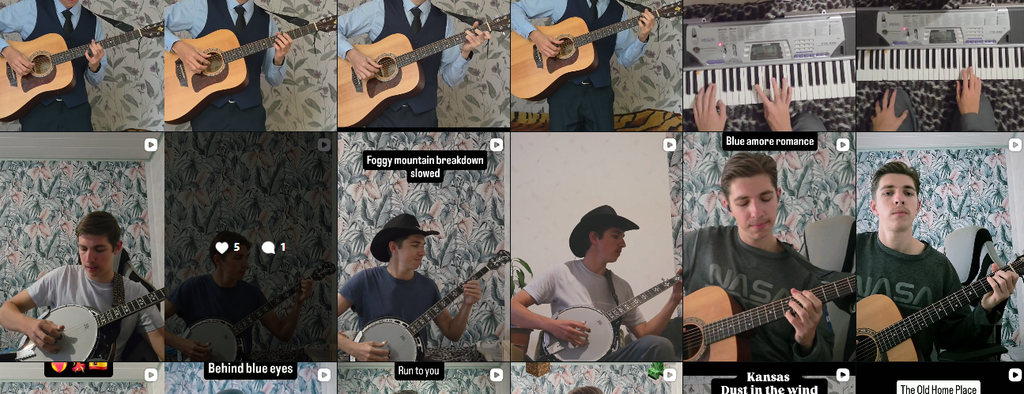
Publish tutorials, videos and posts that teach something. A short video lets a student hear how you explain a chord before they book. Pick one main platform, such as YouTube Shorts or Instagram Reels, and post there for twelve weeks. Have a clear profile line that says what you teach, and regular posting. Video ideas that match what students search:
- Fix one common beginner mistake in 60 seconds.
- Teach the opening riff of a song your students ask for.
- Show a practice routine for a 15-minute day.
- Answer one question a student asked this week.
End every video with the same line: “Lessons are on my website, link in my bio.” Link the bio to your lessons page.
This week: record two 60-second videos that answer questions your students asked.
Step 8: Use local partners, other teachers and directories
Start close to home. David Hart of G4 Guitar wrote that local marketing worked well for him because few guitar teachers do it. He reports enrolling over 3,000 students in two years with local methods.
Ways to work with others:
- Offer a free workshop or sample lessons at a music shop, school or library.
- Meet teachers who teach other styles or levels.
- Register with online teacher directories.
This week: visit one music shop and offer a free 30-minute workshop. Email two teachers who teach a different style.
Step 9: Set your price
Price depends on lesson length, your experience, your city and whether you travel to the student. Longer lessons usually cost more in total, and package deals lower the cost of each lesson. Price can range from $20-$80 per hour.
Set your price this way:
- Write down what five teachers in your area or niche charge.
- Pick a price at or above the middle of that list if you have a clear offer and reviews.
- Sell a package of four lessons with a small discount.
- Raise your price when you have a waiting list.
This week: write down five competitor rates and set your lesson price and package price.
Step 10: Track where students come from
You cannot improve what you do not count. Add one question to your booking form that asks how the student found you. Check your Google Business Profile insights each month. MakeMusic says they show how many people found you, called you, asked for directions or clicked to your site.
Keep four numbers in a note each month:
- Enquiries received.
- Trial lessons booked.
- Trial students who became regular students.
- New Google reviews.
Give each method eight weeks before you judge it. Keep the ones that bring students and drop the ones that bring none.
This week: add the source question to your booking form and start the note.
Your first 30 days
Do the steps in this order. Each week has a small set of tasks.
| Week | Steps | What to do |
|---|---|---|
| 1 | 1, 2, 9 | Write your offer. Rewrite your lessons page. Check five competitor prices and set yours. |
| 2 | 3, 6, 10 | Claim your Google Business Profile. Add a booking link. Add the source question and start your monthly note. |
| 3 | 4, 5 | Ask the five AI questions and save the results. Message three students about referrals. |
| 4 | 7, 8 | Post your first two videos. Visit a music shop. Email two teachers. |
After day 30, keep posting and asking for reviews. Judge each method after eight weeks.
Frequently asked Questions
How do I get my first guitar students?
Start with people you know. Tell friends, family and coworkers that you teach, and offer a free first lesson. Set up your lessons page and Google Business Profile at the same time.
How many students do I need to make a living?
It depends on your price. If you charge $50 per lesson and teach 20 lessons a week, you bill $1,000 a week before costs and taxes.
Do I need a website to get guitar students?
Not in the beginning, but later yes. A lessons page gives every message, video and referral one place to send people. One page with your offer, a video, testimonials and a booking link is enough to start.
Should I teach online or in person?
Online lessons reach students outside your area, as Music Teacher notes. In-person lessons help you show up in local Google search. You can offer both and state each option on your lessons page.
How long does it take to get students?
Referrals and messages to people you know are the fastest, because they need no ranking. New pages and videos take longer to bring in students. Judge each method after eight weeks.
Get a free audit of your guitar teaching website
I work with guitar teachers and coaches on getting more students. Send me your website and I will tell you what to fix first. Request your free audit.